First of all, Marcie and I were deeply saddened by the news from Minnesota of the shooting deaths at the south Minneapolis church school. Horrible.
There isn’t an adequate transition to anything else but here it is anyway. Koshary. Koshary is a basic and is to Egypt as meatballs are to a Norwegian Christmas dinner and is widely considered Egypt’s national dish. Rice, lentils (black or brown), chickpeas and pasta are cooked individually, then tossed together and topped with cumin-scented tomato sauce and crunchy fried onions. Things get kicked up a notch with condiments of garlicky vinegar and a peppery hot sauce called shatta. It’s about carbs and calories…..and Marcie loves it!
The Rosetta stone of koshary cafes is Abu Tarek. Near the church, it started as a food cart in 1950 is now a busy, busy, four-story restaurant. One gets a large helping for 50 cents. Needless to say, we have eaten koshary more than once and we’re not done yet!
It’s Marcie’s birthday! We’re celebrating with our granddaughter, Julia, who’s in town for a few days, by heading to the Khan Khalili, the famous and centuries-old bazaar in the middle of Cairo and then to dinner. A fun day ahead!
Fridays, for the majority Muslim population of Egypt, are called, “Jum’ah,” a day for congregational prayer and gathering together. All men are obligated to attend prayer, while women have the option attend voluntarily. After the prayers, resume their normal activities.
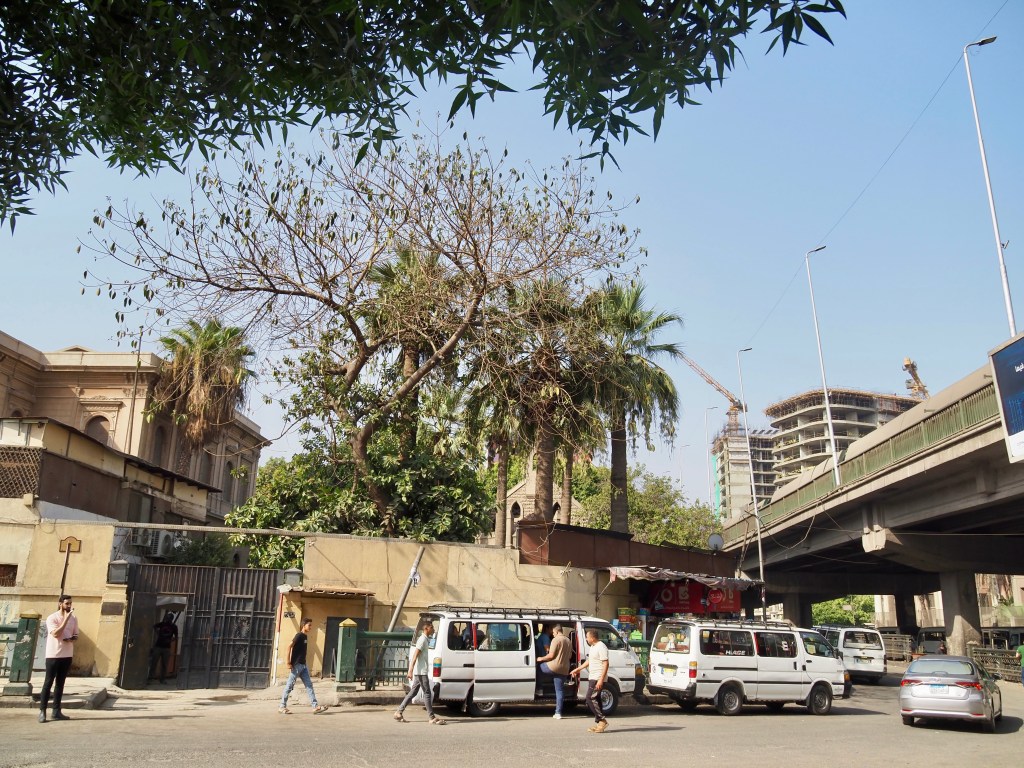
So Friday morning is quiet. The refugee ministry has a day off. We have worship but the church compound is very quiet. A good time to take some photos; a few on the inside and another from across the street. The church was built by Scottish Presbyterians in 1908 and is now tucked between some government buildings, the (usually) busy streets of Cairo, and a main flyover highway through central Cairo.
One of the bittersweet aspects of being back at St. Andrew’s is there are many refugees who are still here for over 20 years.
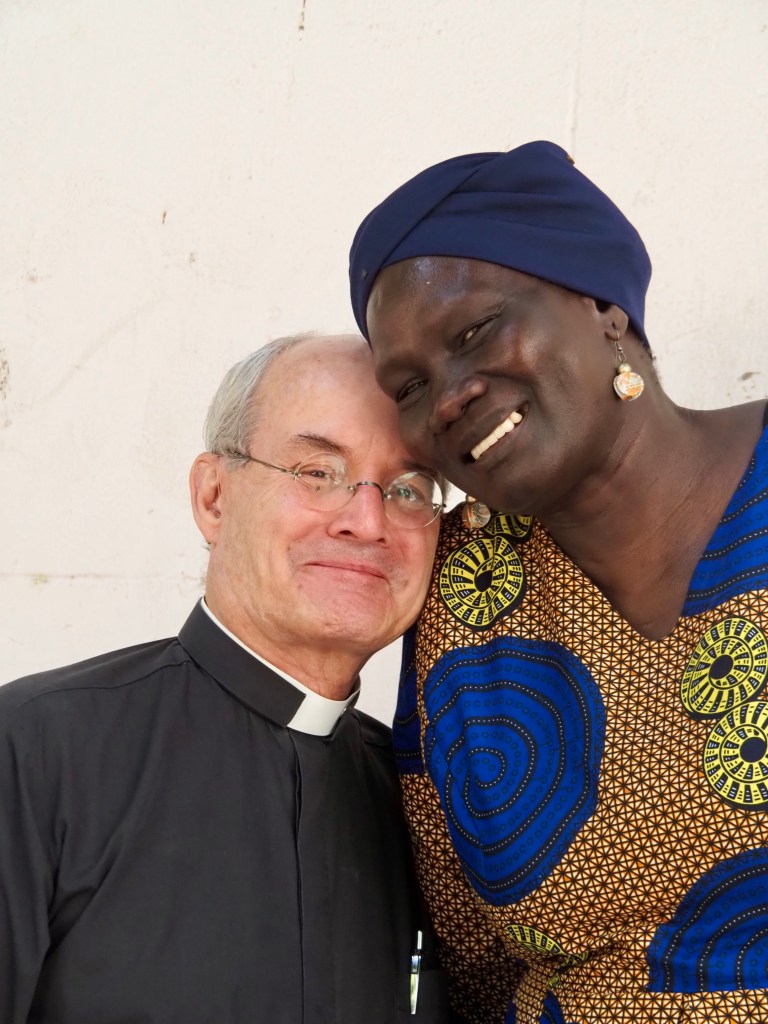
One example is Angelina and her son, Gatdaet, refugees from Sudan. Gatdaet is a remarkable man. He learned English from magazines and watching TV and for a number of years he has been an integral part of the staff here at StARS. He is the go-to person for all things in the refugee ministry and, until recently, his future appeared wide open. He had accepted a scholarship to attend college in Nebraska this fall and was excited to move on. In December, his traveling papers were suddenly put on review by our embassy here and he was unable to leave the country for school.
I first met Gatdaet’s mother, Angelina in the early 2000’s. She had been accosted on the street, knocked to the ground, and all of her front teeth were broken. We were able to get her to the hospital, stay with her, pay the bill, and get her home. Last week, Gatdaet brought his Mom to church. She wanted to thank us for staying with her and helping her out. When she saw me, she began to cry. So did I.
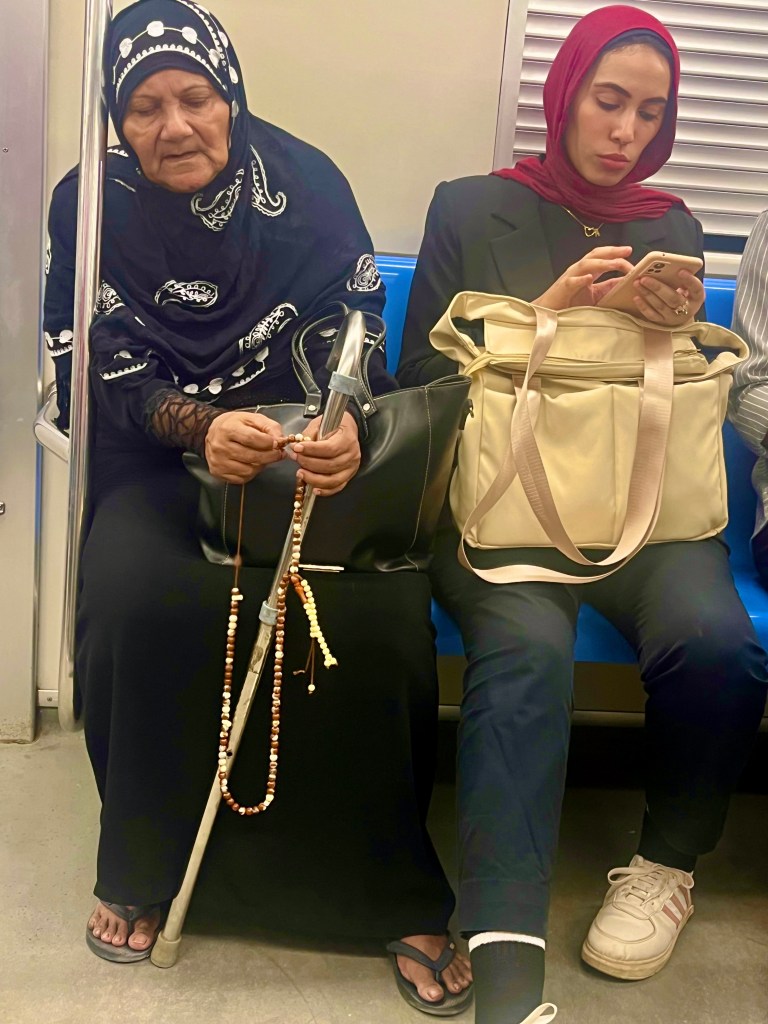
Most every day, Marcie and I make a 30-minute trip to and from St. Andrew’s on the train. Some cars are air-conditioned; most are not. There is a “women only” car. On our car, Marcie took this great photo of two women; one a professional woman and the other a woman praying with her prayer beads.
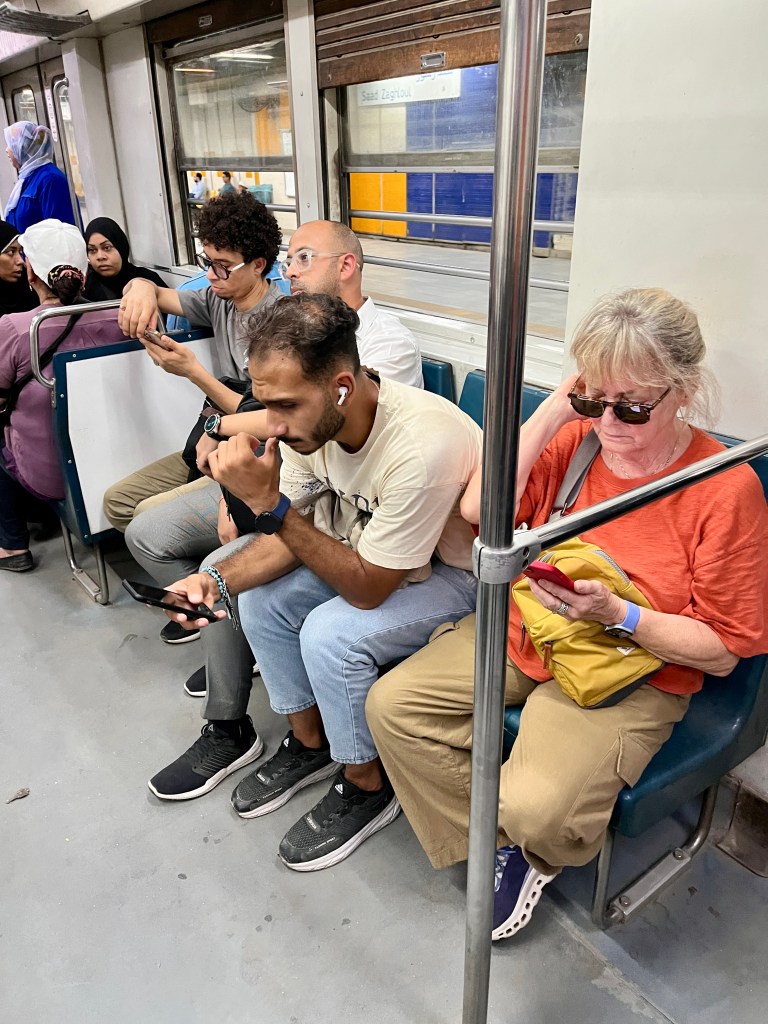
While commuting, we’ve observed that there are certain courtesies to be observed. The cars are clean. One young man I was standing next to dropped a wafer crumb the size of a dime on the floor and a man told him in no uncertain terms to pick it up and he did–without saying a word.
If an older person boards the car and all the seats are full, it is expected that younger people and men will offer their own seat. In two of the photos below, the man in the short-sleeve golf shirt had just ordered the three younger men across from him to move over and give Marcie a seat.
As I mentioned in my first post, St. Andrew’s United Church of Cairo is the home of a significant ministry to refugees—StARS (St. Andrew’s Refugee Services.
With Pastor Bekah, I met this family last week (pictured). They are a good example of those who have both been ministered to, as well as continue to minister to, other refugees. For their protection, I need to withhold their names but let me tell a bit of their story. Due to conflict and violence, Mom fled Ethiopia many years ago to Sudan. There she had two girls; one now in her late teens, the other in her early twenties. There the husband/father abandoned them. Soon life in Sudan became too dangerous and they came here to Cairo where they were assisted by StARS. They would like to return to Ethiopia or emigrate. The problem? They need the husband/father’s permission. They’re stuck. Meanwhile both the young women are working for StARS to help other refugees. We went to their apartment for coffee and ended up being served a whole Ethiopian meal. They are a remarkable family!
Greetings from Cairo, Egypt! Marcie and I are here for seven weeks serving St. Andrew’s United Church of Cairo, Egypt. We returned to a church we served under the aegis of Global Missions of the Evangelical Lutheran Church in America (ELCA) from 2003-2005 and for five weeks in 2016. In that brief stint and this current one we are filling in for the current pastor on home leave, Pastor Bekah Davis.
A little bit about St. Andrew’s. The first worship services of St. Andrew’s were held on February 5, 1899 and the dedication service in the present sanctuary of St. Andrew’s Church was held on January 3, 1909. Worship at St. Andrew’s continued during both World Wars, serving the English-speaking military personnel stationed in Cairo. Aside from an English speaking congregation, St. Andrew’s has been “home” to refugee congregations. Currently, there are seven refugee led congregations whose services are led in the native language of each community.
For the past 46 years, St. Andrew’s has also been home to StARS (or also known as St. Andrew’s Refugee Services). This ministry of the church began when five women over the age of 80 saw a need, both for the congregation and the increasing numbers of refugees being forcibly displaced from countries in the Horn of Africa. At that time, many of the people arriving in Egypt were here to study in Cairo under the auspices of the United Nations High Commission for Refugees (UNHCR). However outside of school they were lacking a place to gather in community. On October 11, 1979, the Thursday evening “Refugee Center” was inaugurated in St. Andrew’s Guild Hall. In its early days, as many as 115 people came for games, conversation, and tea. In the early years there was also a rudimentary effort in English-language instruction. This ministry has grown to a staff of over 600 people, a volunteer base of over 200 people, who are now serving over 100,000 families a year; people from Ethiopia, Iraq, Sudan, South Sudan, Yemen, Somalia, Eritrea, and Syria.
It’s a marvelous ministry and effort by many, many people!






 Mark Nelson's Blog